Speech therapy after stroke helps many survivors regain their ability to speak, understand language, read, write, and swallow safely. It works best when it starts early, follows a plan built for the individual patient, and includes daily practice at home with family support. This guide explains what speech therapy after stroke involves, when to start it, the steps that bring the fastest progress, and how families in Lahore can support recovery.
Key Takeaways
- Speech therapy after stroke treats aphasia, unclear speech, and swallowing problems, not just pronunciation.
- Starting early gives the brain its best chance to rebuild language skills, and progress can continue for months and years.
- Short daily practice at home matters as much as formal therapy sessions.
- Families speed recovery when they listen patiently, keep sentences simple, and celebrate every successful message.
- Ask your doctor for a referral to a qualified speech and language therapist as soon as the patient is medically stable.
What Speech Therapy After Stroke Actually Treats
A stroke can damage the parts of the brain that control language, speech muscles, and swallowing. Speech therapy after stroke addresses each of these problems with different techniques, because no two patients face exactly the same challenge.
Aphasia after stroke affects language itself. A person with aphasia may know what they want to say but cannot find the words, or they may struggle to understand what others say. Some patients speak fluently but their words make little sense. Others understand everything yet cannot produce a single sentence. A therapist first identifies the type of aphasia, then builds exercises around naming objects, understanding instructions, reading, and writing.
Dysarthria after stroke affects the muscles used for speech. The tongue, lips, and jaw may feel weak or poorly coordinated, so speech sounds slurred or quiet even though language understanding stays intact. Therapy for dysarthria focuses on strengthening these muscles, controlling breath while speaking, and speaking slowly and clearly.
Swallowing problems, known as dysphagia, also fall under speech therapy after stroke. A therapist assesses whether food or drink enters the airway, then recommends safe food textures, swallowing exercises, and posture changes that reduce the risk of chest infection.
When Should Speech Therapy After Stroke Start?
Speech therapy after stroke should start as soon as doctors confirm the patient is medically stable, often within the first days in hospital. Early assessment matters because it identifies swallowing risk quickly and sets a baseline for language skills before bad habits form.
Many families worry that starting early will tire the patient. In practice, early sessions stay short and gentle, often just 20 to 30 minutes on simple tasks such as naming familiar objects or practising safe swallowing. As stamina improves, sessions grow longer.
Starting late does not mean recovery is impossible. The brain keeps adapting for a long time after a stroke, and many patients make real gains months or even years later. Still, the fastest progress usually happens in the first six months, so ask for a referral now, even if the patient still feels very weak.
7 Proven Steps in Speech Therapy After Stroke
Every recovery plan looks different, but effective speech therapy after stroke usually follows the same seven steps. Use this list to understand what your therapist does and what you can practise at home.
Step 1: Get a Full Assessment
The therapist tests understanding, speaking, reading, writing, and swallowing. The assessment shows which skills need the most work and gives the family a clear starting point. Keep a copy of the assessment so you can track progress over time.
Step 2: Set Small, Practical Goals
Good goals describe real life, not test scores. Examples include ordering food, calling a family member, or asking for help at home. Small goals keep motivation high because the patient sees progress every week.
Step 3: Practise Naming and Word Finding Daily
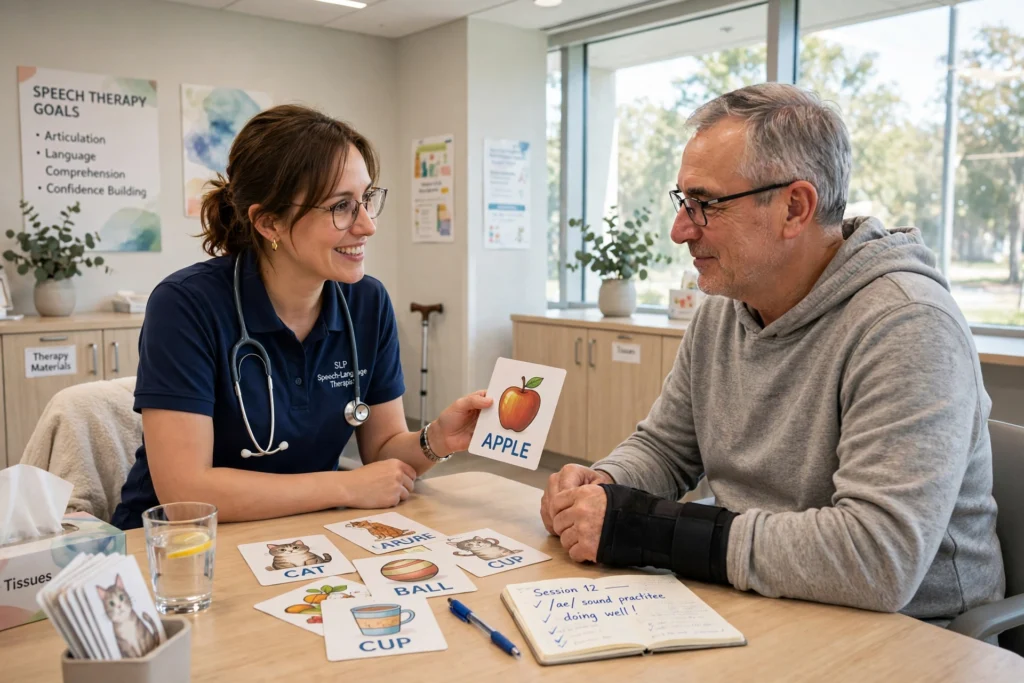
Speech exercises after stroke often start with naming. Show a photo of a common object and ask the patient to name it. If the word does not come, give a hint such as the first sound or a description of what the object does. Practise for 15 to 20 minutes, twice a day, rather than in one exhausting session.
Step 4: Use Conversation, Not Just Drills
Drills build skills, but conversation builds confidence. Talk about the news, family events, or a favourite meal. Let the patient lead when possible, and resist the urge to finish their sentences.
Step 5: Strengthen Speech Muscles and Breath Control
For dysarthria after stroke, the therapist prescribes tongue, lip, and jaw exercises, plus breathing practice. Speak slowly, take a breath before each phrase, and exaggerate mouth movements at first. Clear speech matters more than fast speech.
Step 6: Practise Speech Therapy at Home After Stroke
Speech therapy at home after stroke turns a weekly session into daily progress. Read a short paragraph aloud together, sing familiar songs, play word games, and label objects around the house. Keep a simple notebook of new words learned each week so the patient can see the gains.
Step 7: Use Tools That Support Communication
Picture boards, communication apps, and simple writing pads help when speech fails. These tools do not replace speech therapy after stroke. They reduce frustration, keep the patient connected to family life, and give the brain more ways to practise language while speech recovers.
How Long Does Speech Therapy Take After Stroke?
Families often ask how long does speech therapy take after stroke. Speech therapy after stroke timelines vary widely, and the honest answer depends on the individual patient. Some patients with mild aphasia improve noticeably within weeks. Patients with severe aphasia may need therapy for a year or longer, with progress coming in bursts rather than a straight line.
Three factors shape the timeline most. First, stroke size and location matter: damage to language areas usually needs longer therapy. Second, practice intensity matters: patients who practise daily progress faster. Third, overall health matters: good sleep, controlled blood pressure, and treatment for low mood all support recovery.
Do not stop therapy just because progress slows. Plateaus happen in every recovery. A therapist can change the exercises, raise the difficulty, or shift the focus to a new skill, and progress often restarts after a change of approach.
How Families Can Help Every Day
Family support makes a measurable difference in speech therapy after stroke. Speak in short, clear sentences and give the patient time to answer. Use gestures, pictures, and written words alongside speech when they help. Keep background noise low during important conversations, and sit face to face so the patient can watch your mouth movements.
Avoid correcting every mistake. Constant correction discourages patients and makes them afraid to try. Instead, repeat the message back correctly in a natural way so they hear the right version without feeling criticised.
Watch for low mood and frustration. Depression after a stroke is common and it slows language recovery. If the patient withdraws, sleeps far more than usual, or loses interest in therapy, raise it with the doctor promptly.
Finding Speech Therapy in Lahore
Families in Lahore can access speech therapy after stroke through hospital rehabilitation departments, private clinics, and home visit services. Ask the treating neurologist for a referral, and check that the therapist holds recognised qualifications. Before the first session, ask about assessment, session length, home practice plans, and costs.
If travel is difficult, ask about home based therapy or video sessions. Home sessions work well because the therapist can practise real tasks such as talking at the dining table. Whatever setting you choose, consistency matters most: regular sessions plus daily home practice beat occasional sessions at a famous clinic.
Frequently Asked Questions
Can speech return fully after a stroke?
Some patients regain full speech, especially when the stroke was mild and speech therapy after stroke started early. Others regain enough speech to communicate well in daily life even if some word finding difficulty remains. Full recovery depends on stroke severity, brain area affected, and practice intensity, so a therapist can give a realistic outlook only after assessment.
What is the difference between aphasia and dysarthria?
Aphasia after stroke affects language: finding words, understanding speech, reading, and writing. Dysarthria after stroke affects speech muscles: the patient knows the words but cannot pronounce them clearly. Some patients have both, and therapy addresses each problem separately.
Are speech therapy apps useful?
Apps can support practice between sessions, especially for naming and reading exercises. They work best when a therapist selects the app and reviews progress regularly. Apps alone rarely replace a therapist, because only a therapist can judge whether an exercise targets the right skill at the right difficulty.
When should we seek urgent help?
Seek urgent medical help if swallowing causes coughing or choking, if speech suddenly worsens, or if new weakness, confusion, or severe headache appears. These signs may indicate another stroke or a complication that needs immediate attention.
Medical disclaimer: This article provides general information only and does not replace professional medical advice. Always consult a qualified doctor or speech and language therapist about diagnosis and treatment for a specific patient.
Medically reviewed by the Quick Neuro Relief clinical team, Lahore