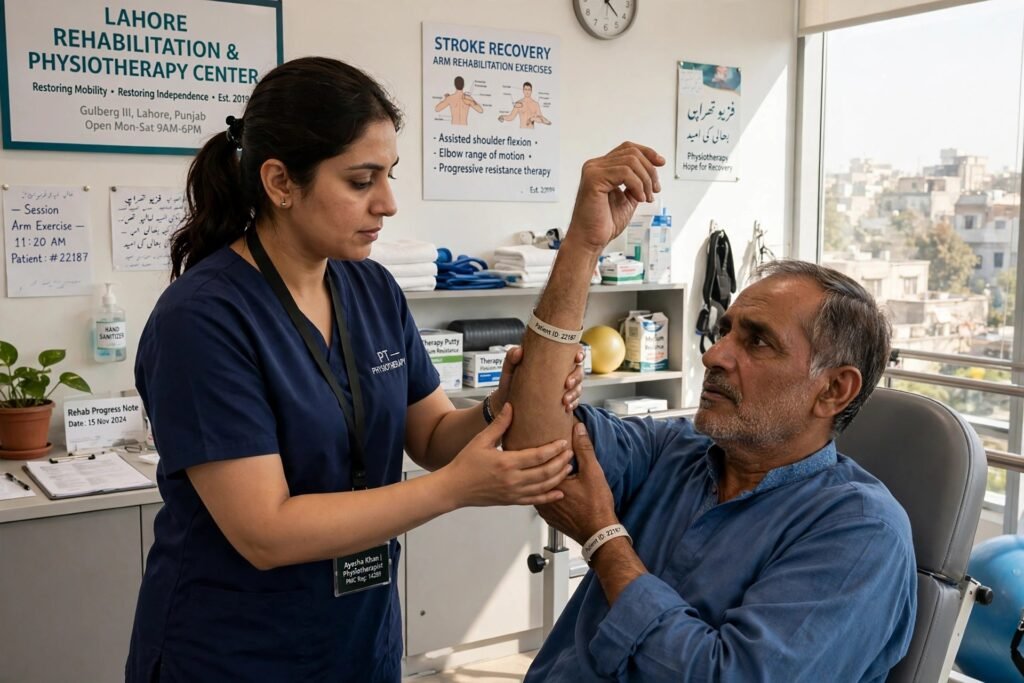
Stroke rehabilitation exercises rebuild strength, balance and coordination after a stroke. They include arm and leg movements, balance training, grip work and guided gait practice. Starting them early, under professional guidance, gives stroke patients the best chance of regaining independence.
Key Takeaways
- Stroke rehabilitation exercises work best when they start early and repeat often; consistent daily practice drives neuroplasticity, the brain’s ability to rewire itself.
- The most effective programs mix arm and shoulder work, leg and balance training, hand and grip exercises, and supervised walking practice.
- Family members can support recovery at home by following the exact plan set by a physiotherapist and tracking small improvements week by week.
- Stop any exercise that causes sharp pain, severe dizziness or unusual fatigue, and report these signs to the treating doctor immediately.
Why Stroke Rehabilitation Exercises Matter for Recovery
A stroke damages brain cells that control movement. Stroke rehabilitation exercises force the brain to build new neural pathways around the damaged area. This process, called neuroplasticity, responds best to repeated, purposeful movement. Research and clinical experience both show that patients who follow a structured exercise program regain more function than patients who stay inactive.
Timing matters. Rehabilitation usually begins within 24 to 48 hours after the stroke, often while the patient still stays in hospital. Early movement prevents joint stiffness, muscle wasting and blood clots. As the patient stabilizes, the program grows to include harder stroke rehabilitation exercises that challenge strength, balance and fine motor skills.
Every stroke differs. A person with mild arm weakness needs different stroke rehabilitation exercises than a person who cannot walk. A physiotherapist assesses the damage, sets realistic goals and designs a program around the patient’s specific deficits. This article explains the core movements used in most programs, so families understand what recovery involves and can support it properly at home.
10 Essential Stroke Rehabilitation Exercises
The following exercises cover the full body. Perform each one exactly as a physiotherapist prescribes. The suggested repetitions are starting points; the therapist adjusts them to the patient’s ability.
1. Shoulder Raises (Arm Strength)
Sit upright in a chair with feet flat on the floor. Lift the weaker arm straight up beside the head, then lower it slowly. If the arm cannot lift on its own, use the stronger hand to guide it. Repeat 10 times. This movement maintains shoulder mobility and prevents the frozen shoulder that often follows paralysis.
2. Table Tapping (Arm Reach)
Sit at a table. Place both hands flat on the surface. Slide the weaker hand forward as far as possible, then back. Repeat 10 times. This simple exercise rebuilds reaching ability used in dressing, eating and personal hygiene.
3. Ball Squeezes (Grip Strength)
Hold a soft rubber ball or a rolled towel in the affected hand. Squeeze firmly for 5 seconds, then release. Repeat 10 times. Grip work ranks among the most important rehab exercises because hand function decides whether a patient can hold a spoon, button a shirt or open a door.
4. Finger Opposition (Fine Motor Skills)
Touch each fingertip to the thumb, one at a time, forming an “O” shape. Go slowly and focus on control. Repeat the full cycle 5 times. These precise movements retrain the brain circuits that control dexterity.
5. Seated Marching (Hip and Knee Strength)
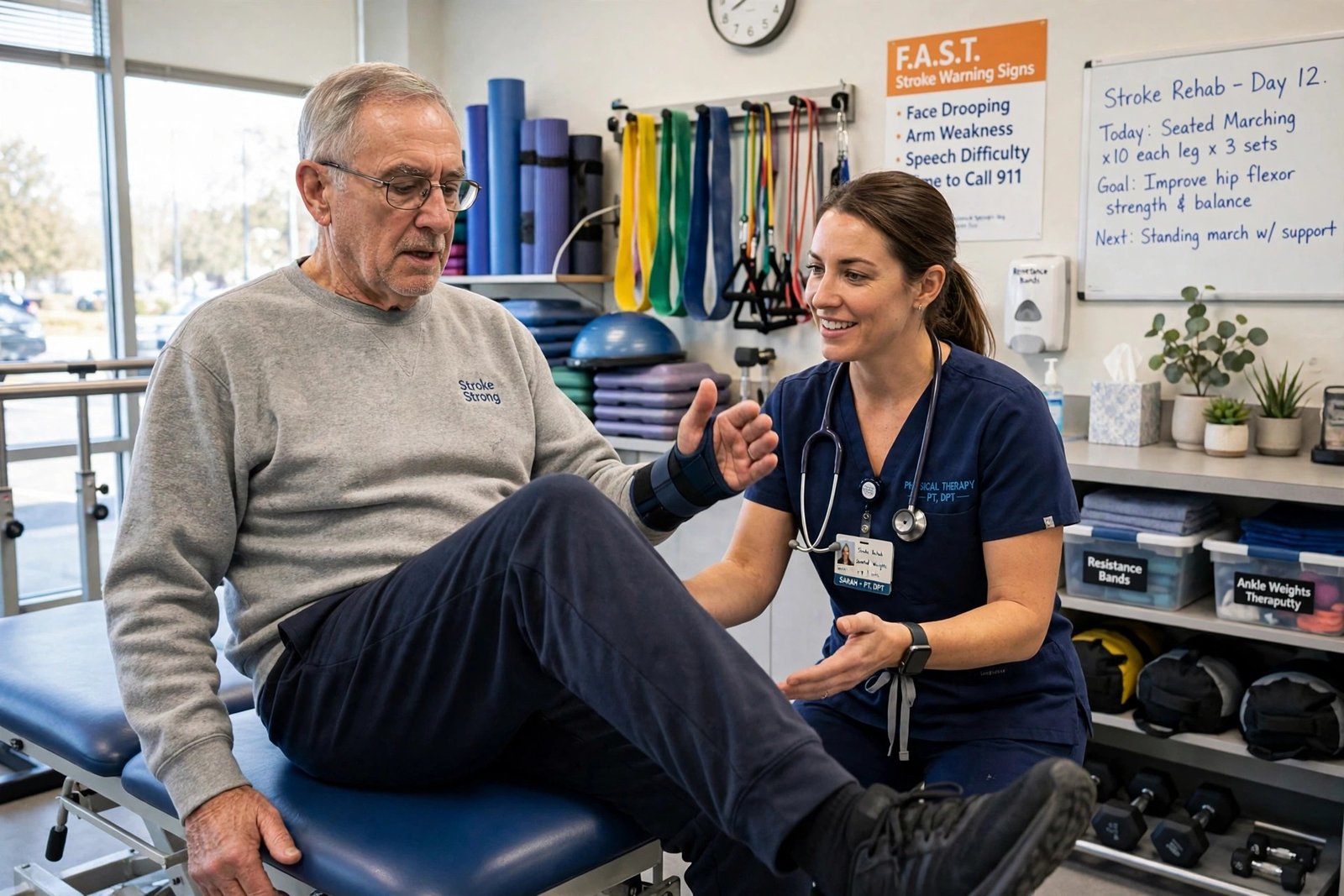
Sit in a sturdy chair. Lift one knee as high as comfortable, then lower it. Alternate legs, like marching in place. Repeat 10 times per leg. Seated marching belongs to the leg group of rehab exercises and builds the strength needed for standing.
6. Ankle Pumps (Calf Activation)
Sit or lie down with legs extended. Point the toes away from the body, then pull them back toward the shin. Repeat 15 times. Ankle pumps keep blood flowing in the legs, reduce swelling and fight the foot drop that affects many stroke patients.
7. Standing Weight Shifts (Balance)
Stand behind a chair and hold its back for support. Shift body weight onto one leg, hold for 10 seconds, then shift to the other. Repeat 8 times per side. Balance focused exercises reduce fall risk, which remains one of the biggest dangers during recovery.
8. Sit to Stand Practice (Functional Strength)
Sit in a chair with feet flat. Lean slightly forward, then push through the legs to stand. Lower back down slowly. Repeat 8 times. This functional stroke rehabilitation exercise trains the exact movement used to get out of bed, chairs and cars.
9. Guided Walking (Gait Training)
Walk short distances with a therapist, family member or walker beside the patient. Focus on heel strike first, then roll through to the toes. Start with a few meters and add distance gradually. Guided walking pulls many rehab movements together into real world movement.
10. Mirror Therapy (Arm Activation)
Place a mirror between the arms so the patient sees the reflection of the strong arm where the weak arm should be. Move the strong arm while watching its reflection. The brain interprets the image as the weak arm moving, which can trigger real improvement in the affected limb. Practice for 15 minutes daily.
How to Perform Stroke Rehabilitation Exercises Safely at Home
Home practice accelerates recovery, but safety comes first. Follow these rules:
- Clear the exercise area of rugs, wires and clutter that could cause a fall.
- Always have a family member nearby during standing or walking practice.
- Warm up with gentle movements for 5 minutes before the main session.
- Split practice into 2 or 3 short sessions daily instead of one exhausting session.
- Track repetitions and any difficulties in a simple notebook, so the physiotherapist can adjust the plan.
- Use supportive shoes, not socks or slippers, for standing exercises.
Common Mistakes During Stroke Rehabilitation Exercises
Families mean well but sometimes push too hard. Avoid these errors:
- Skipping rest days. Muscles and the brain need recovery time. Follow the schedule the therapist sets.
- Forcing painful movement. Discomfort differs from pain. Sharp or increasing pain signals a problem; stop and consult the doctor.
- Practicing without supervision early on. Newly mobile patients fall easily. A spotter prevents setbacks.
- Copying exercises from random videos. Stroke rehabilitation exercises must match the individual’s deficits. Generic routines can reinforce bad movement patterns.
- Expecting overnight results. Neuroplasticity builds over weeks and months. Small steady gains beat rushed intensity.
When to Progress Your Stroke Rehabilitation Exercises
Progress when the current exercises feel easy and the therapist agrees. Signs of readiness include completing all repetitions without fatigue, moving with better control, and performing daily tasks more independently. Progression means more repetitions, added resistance bands, reduced support during standing, or new challenges like stairs.
Do not progress on your own schedule. A physiotherapist reassesses regularly and upgrades the program at the right moment. Premature jumps cause injuries that slow recovery.
Frequently Asked Questions
How often should a stroke patient do rehabilitation exercises?
Most patients benefit from daily practice, often split into 2 or 3 sessions of 20 to 30 minutes. The physiotherapist sets the exact frequency based on the patient’s stamina and stage of recovery.
Can stroke rehabilitation exercises be done entirely at home?
Home practice matters, but it should not replace professional supervision, especially in the first months. A therapist guides technique, prevents compensation habits and progresses the program. Many families in Lahore combine clinic sessions with structured home practice for the best results.
What if the patient cannot move the affected arm or leg at all?
Passive exercises still help. The therapist or caregiver gently moves the limb through its range of motion. This keeps joints flexible and sends sensory signals to the brain. Movement often returns gradually with consistent passive work.
Are stroke rehabilitation exercises painful?
Properly prescribed rehab exercises should not cause sharp pain. Some muscle effort and mild soreness are normal. Pain signals overuse, wrong technique or a medical issue, so report it to the doctor rather than pushing through it.
How long does stroke rehabilitation take?
Recovery timelines vary widely. Most rapid improvement happens in the first 3 to 6 months, but gains continue for a year or longer. Some patients keep improving with regular practice well beyond that window.
Do rehabilitation exercises help years after a stroke?
Yes. The brain retains some plasticity throughout life. Starting or restarting rehab exercises years later can still produce meaningful functional gains, though progress usually comes more slowly than in the first year.
Disclaimer: This article provides general information about stroke rehabilitation exercises and does not replace medical advice. Always follow the treatment plan of your doctor and physiotherapist. If any exercise causes pain, dizziness or unusual fatigue, stop immediately and seek medical guidance.
Medically reviewed by the Quick Neuro Relief clinical team, Lahore.